
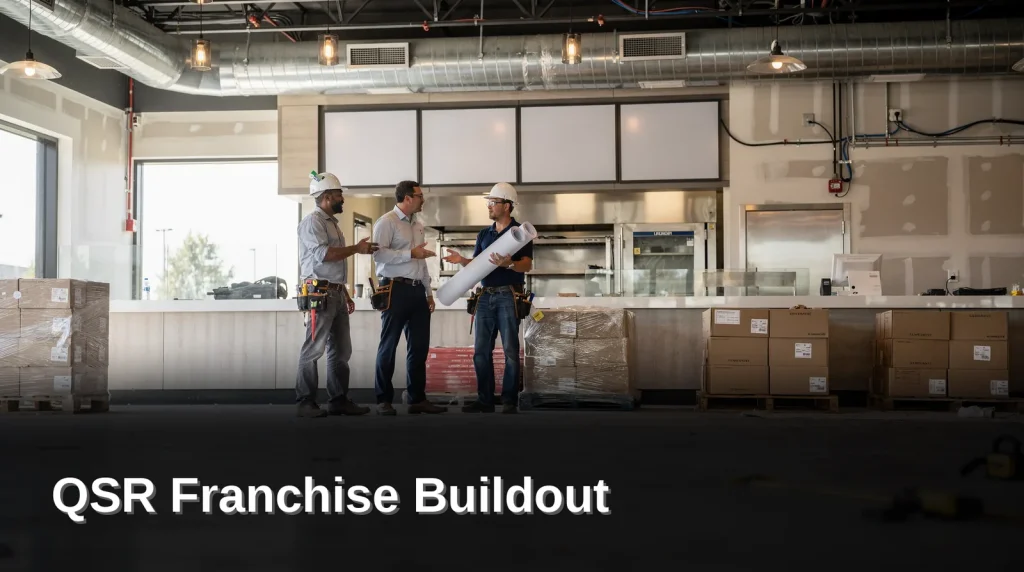
QSR franchise buildouts require precise coordination of lease-driven timelines, prototype specifications, and tenant improvement allowances. Build-out costs range from $40 to $480 per square foot depending on shell condition. MHL Solutions, Inc. delivers turnkey project management across Georgia, North Carolina, South Carolina, and Tennessee, ensuring each location opens on time and within budget.
What drives QSR franchise buildout costs?
A QSR franchise buildout cost depends on three variables: construction type, shell condition, and scope. Ground-up construction carries the highest price tag. Tenant improvements inside existing shells cost far less per square foot.
The cost spread is wide. Building a fast food restaurant from the ground up typically costs between $1.3 million and $2.5 million for a standard 1,800 square foot establishment, according to TCG’s 2026 guide. That figure includes design, permits, site work, and full mechanical systems.
Commercial tenant improvements follow a different cost curve. Build-out costs range from $40 to $480 per square foot depending on shell condition and scope. A warm shell with existing HVAC and plumbing sits at the low end. A cold shell requiring new mechanical, electrical, and fire suppression lands at the high end.
What cost factors should franchise owners evaluate first?
Franchise owners should evaluate four cost drivers before signing a lease or purchase agreement.
- Shell condition. A second-generation restaurant space with existing grease traps, hoods, and utility stubs reduces build-out costs substantially.
- Prototype requirements. Franchisor-mandated finishes, equipment packages, and signage add fixed costs that vary by brand.
- Site work scope. Pad sites require grading, utility extensions, and parking lot construction. Inline spaces avoid most site work.
- Permitting jurisdiction. Municipalities across Georgia, North Carolina, South Carolina, and Tennessee enforce different code cycles and inspection timelines.
How does a franchise construction contractor control these costs?
A franchise construction contractor controls costs through pre-construction planning and prototype discipline. MHL Solutions, Inc. delivers turnkey project management from pre-construction to grand opening, with a dedicated focus on commercial interiors and franchise prototype rollouts. The company’s multi-unit expertise across four states helps franchise owners avoid change orders and schedule slippage.
Selecting the right contractor matters more than the initial bid. Owners should review commercial restaurant build-out contractor qualifications before committing to a build partner. Kitchen experience, code compliance history, and on-time delivery records separate reliable contractors from costly delays.
How do you plan commercial tenant improvements?
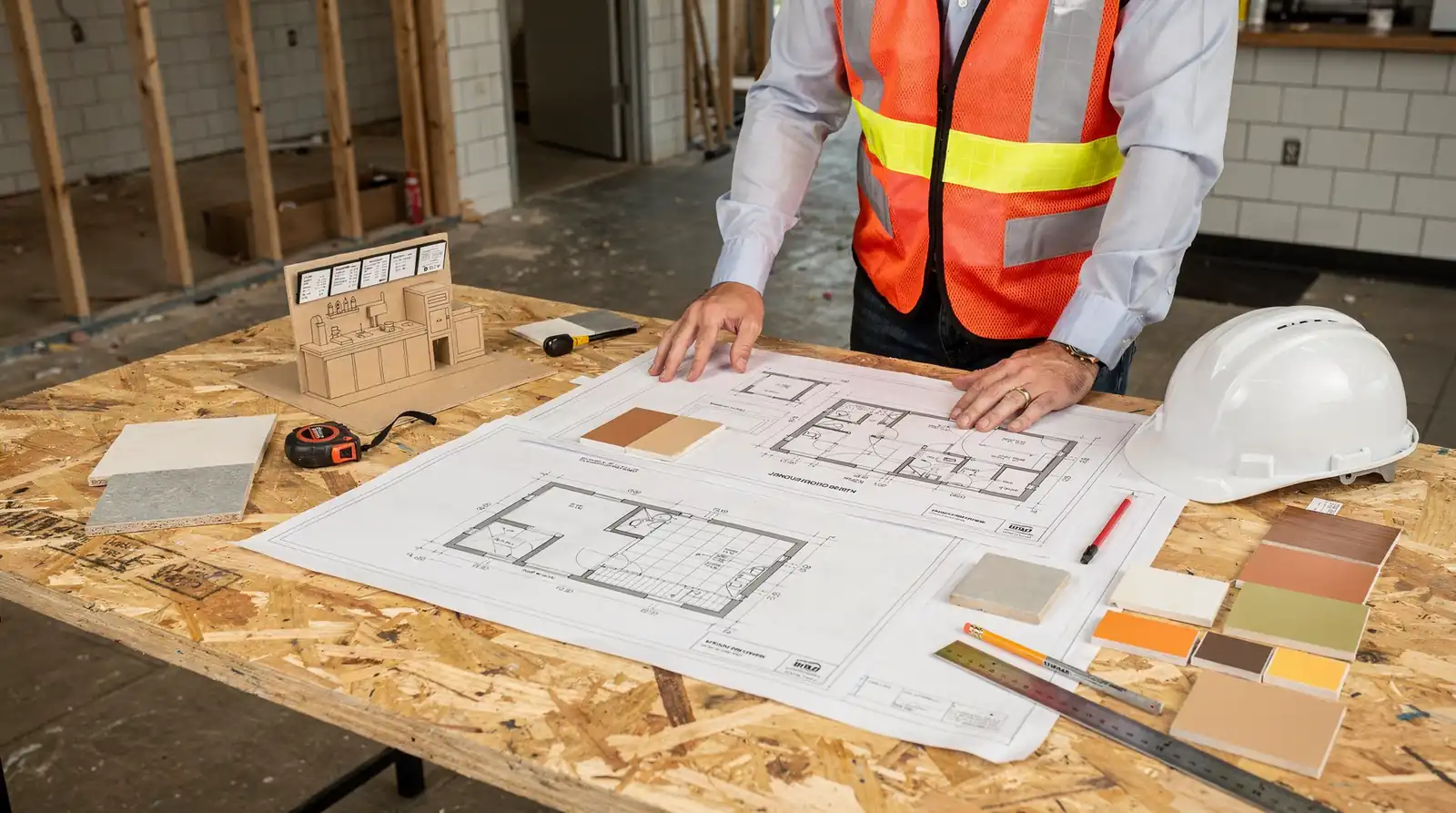
Planning commercial tenant improvements starts with a clear understanding of the leased space and the business requirements it must support. A bare or outdated space transforms into a functional business environment only when the planning phase addresses operational needs, branding goals, and lease obligations. Skipping this phase leaves a business occupying a shell that works against productivity from day one.
The planning process follows a structured sequence. Each step builds on the previous one, and missing a step creates costly rework later.
What are the first steps in planning tenant improvements?
- Review the franchisor’s requirements. Before any construction begins, the franchisee must thoroughly understand the franchisor’s standards. These include specific design elements, materials, and operational equipment that are non-negotiable.
- Assess the shell condition. The existing space determines what modifications are possible and what the build-out costs will be. A bare shell requires different planning than an outdated but functional interior.
- Define the scope with a franchise construction contractor. A franchise construction contractor with multi-site experience translates the brand prototype into a site-specific plan. This step aligns the franchisor’s standards with the physical constraints of the leased space.
- Establish the timeline and budget. Lease dates and landlord allowances drive the schedule. The plan must account for equipment lead times and permitting before any work begins.
How does a multi-unit rollout change the planning process?
A QSR franchise buildout across multiple locations is not twelve separate construction jobs. It is one coordinated program with twelve addresses. The planning phase must replicate a single brand prototype across every site, demanding identical quality, materials, and timelines at each location. Franchisees who treat each site as an independent project risk fragmented results.
MHL Solutions, Inc. approaches planning as a turnkey process. The company’s office buildout planning guide outlines the same discipline for commercial interiors: define requirements first, then budget, then execute. For multi-unit operators across Georgia, North Carolina, South Carolina, and Tennessee, this planning rigor protects the opening date and the brand standard at every location.
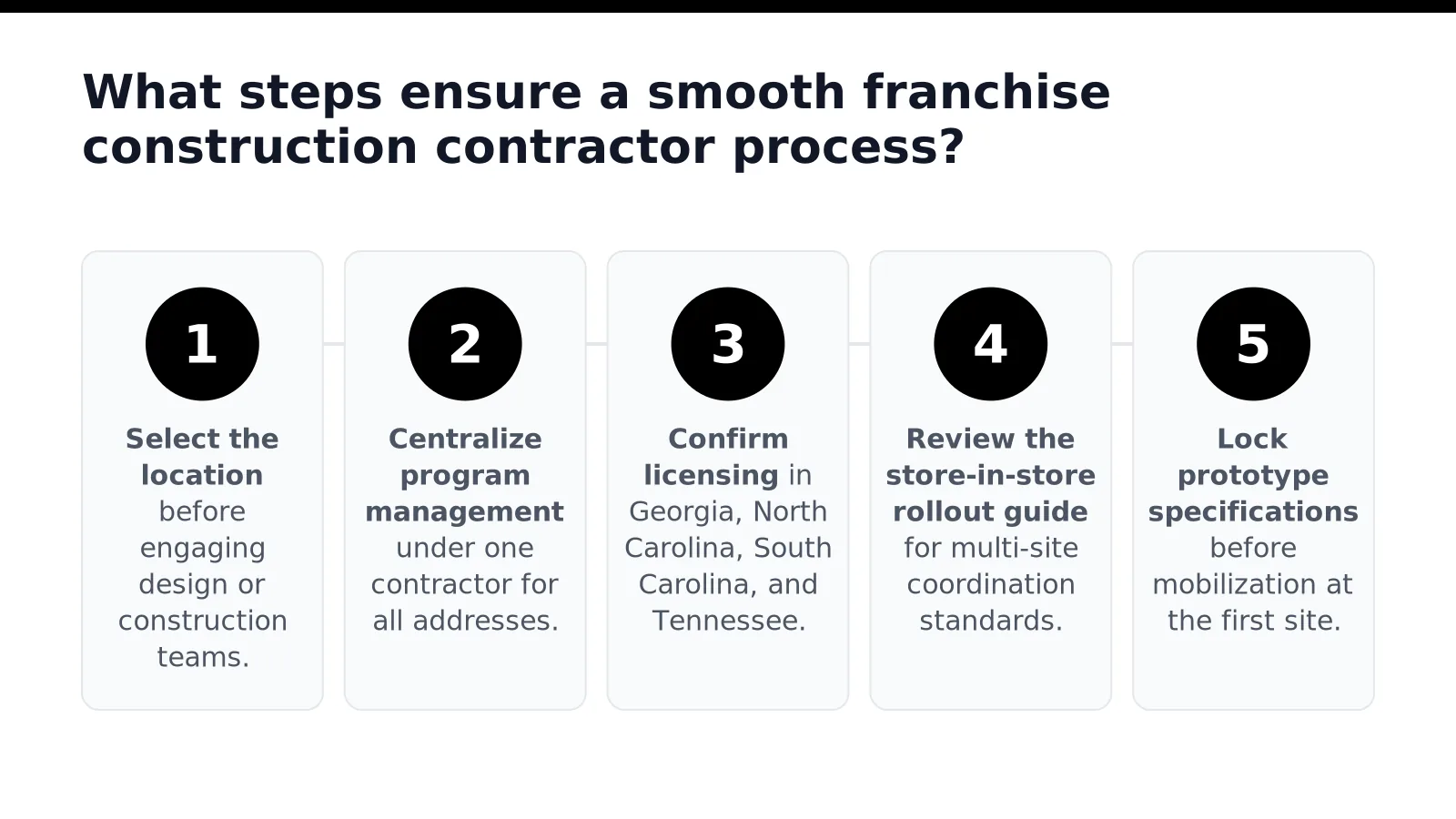
What steps ensure a smooth franchise construction contractor process?
A smooth franchise construction contractor process starts with centralized oversight and ends with on-time delivery. MHL Solutions, Inc. operates as a licensed General Contractor across Georgia, North Carolina, South Carolina, and Tennessee, giving multi-unit operators one accountable partner for every address.
A rollout is not twelve separate construction jobs. It is one program with twelve addresses. Without centralized oversight, brands face twelve different budgets, twelve different schedules, and twelve different quality standards.
What should franchise owners verify before hiring a contractor?
Confirm the contractor holds a valid general contractor license in every state where locations will open. MHL Solutions, Inc. maintains licensing across all four states in its service area. Verify multi-site experience, not just single-project credentials.
What is the first step in the build-out process?
Choosing the right location is critical. The site selection decision locks in lease terms, landlord allowances, and shell conditions that shape every downstream cost. A contractor with regional market knowledge helps franchisees evaluate locations against prototype requirements before signing.
Follow these steps to keep the process on track:
- Select the location before engaging design or construction teams.
- Centralize program management under one contractor for all addresses.
- Confirm licensing in Georgia, North Carolina, South Carolina, and Tennessee.
- Review the store-in-store rollout guide for multi-site coordination standards.
- Lock prototype specifications before mobilization at the first site.
MHL Solutions, Inc. delivers turnkey project management from pre-construction through grand opening. The company’s commercial tenant improvements expertise ensures each leased space meets code and brand standards. For QSR franchise buildout programs, centralized oversight prevents the cost overruns and schedule drift that plague fragmented rollouts.
How do you manage MEP requirements and timelines?
MEP coordination determines whether a QSR franchise buildout opens on schedule or stalls for weeks. Mechanical, electrical, and plumbing systems represent the most complex and inspection-intensive phase of any restaurant construction project. Delays in these trades cascade into failed health inspections, postponed equipment commissioning, and revenue losses that no operator can recover.
MHL Solutions applies a design-build approach that integrates plumbing, electrical, and mechanical systems early in the planning phase. This proactive coordination prevents the costly delays that occur when subcontractors discover conflicts between ductwork and fire suppression lines mid-installation. The company’s licensing across Georgia, North Carolina, South Carolina, and Tennessee ensures every jurisdiction’s code requirements are addressed before rough-in begins.
What MEP systems does a restaurant tenant actually need?
A restaurant tenant requires commercial-grade infrastructure that far exceeds standard office buildouts. The scope includes plumbing systems sized for high-volume use, grease traps that meet municipal wastewater codes, ventilation hoods with dedicated makeup air units, and fire suppression systems tied to cooking equipment. Three-phase electrical power supports commercial kitchen equipment that single-phase service cannot handle.
Commercial tenant improvements for food service also demand gas line routing for fryers and ranges, floor drains positioned for health department compliance, and water heaters capable of sustaining peak demand across dishwashers and hand sinks simultaneously. Missing any one of these elements triggers a failed inspection and a delayed opening.
How does early MEP coordination prevent construction delays?
Early MEP coordination eliminates the conflicts that surface when trades work from separate drawings. MHL Solutions brings mechanical, electrical, and plumbing contractors together during design development. This collaboration identifies clearance issues between exhaust hoods and structural beams before steel is ordered. It confirms that electrical panels have capacity for refrigeration loads before concrete is poured. The result is a franchise construction contractor delivering projects on time and within budget, reflecting a commitment to quality and client satisfaction that multi-unit operators depend on across every rollout.
A commercial kitchen contractor with restaurant-specific expertise understands that MEP rough-in sequencing drives the entire construction schedule. Inspections cannot be scheduled until rough-in is complete. Equipment cannot be set until inspections pass. Every day of MEP delay pushes the opening date further out.
What common mistakes delay QSR franchise buildouts?
Fragmented project management delays QSR franchise buildouts more than any single construction issue. It is one program with twelve coordinated openings.
Without centralized oversight, brands face twelve different budgets, twelve different schedules, and twelve inconsistent store appearances. This fragmentation erodes brand equity and delays revenue across the entire portfolio. The cost compounds with every additional location.
What happens when franchisees manage each site independently?
The consequences appear quickly. Each site develops its own timeline, its own vendor relationships, and its own interpretation of brand standards. One location opens on schedule while another stalls over permit revisions. A third site substitutes materials that fail prototype specifications.
MHL Solutions, Inc. builds trust through full attention to detail in every project from the start. The company commits to delivering quality and sustainability in construction services, reflecting family-owned values that prioritize long-term client relationships over short-term volume.
How does centralized oversight prevent these delays?
A franchise construction contractor with multi-site expertise applies one standard across every address. The contractor coordinates commercial tenant improvements under a single program structure. This approach eliminates duplicated discovery work and keeps all twelve sites moving toward the same opening window.
The design-build construction model integrates design and construction under one entity, which minimizes project timelines and simplifies management for franchise operators. MHL Solutions manages these complex projects with budget certainty and schedule discipline.
The most common mistakes share one root cause: treating a coordinated rollout as a collection of unrelated jobs. Centralized oversight prevents that error before the first permit application is filed.
Conclusion
A QSR franchise buildout program succeeds when centralized oversight replaces fragmented project management. Franchisees who commit to a single contractor with regional licensing and design-build expertise eliminate the schedule drift and cost overruns that stall independent rollouts. The next step is selecting a partner who coordinates MEP requirements, tenant improvements, and prototype standards across every address from pre-construction through grand opening.