
A multi-unit franchise rollout demands a general contractor with proven systems for speed and brand consistency. MHL Solutions, Inc. delivers turnkey project management across Georgia, North Carolina, South Carolina, and Tennessee, handling everything from pre-construction to grand opening. This roadmap ensures every prototype opens on time and within budget.
What is a franchise prototype rollout?
A franchise prototype rollout constructs multiple locations of a brand’s standard design across different sites. The process replicates a proven store model with exacting precision, ensuring every new unit matches the original specifications. Without this consistency, a franchise network fragments and loses the operational efficiency that makes the model profitable.
MHL Solutions, Inc. executes these rollouts as a licensed General Contractor across Georgia, North Carolina, South Carolina, and Tennessee. The company specializes in multi-unit retail construction, quick-service restaurant buildouts, and store-in-store deployments inside major retail environments. Each location follows the same architectural plans, material specifications, and construction sequencing. Deviations from the prototype introduce costly delays and erode the customer experience that drives repeat business.
Why does prototype consistency matter for franchise growth?
Consistency across prototypes protects brand integrity and streamlines operations. A multi-unit retail buildout program depends on repeatable processes that franchisees and corporate teams execute with confidence. When every location looks and functions identically, training costs drop, supply chains simplify, and customers recognize the brand immediately. The development partner designs and executes the full system required to grow with speed, consistency, and brand integrity.
How does turnkey construction support prototype rollouts?
A turnkey franchise construction approach manages the entire project from pre-construction through grand opening. The contractor handles permitting, material procurement, subcontractor coordination, and final inspections. Franchise owners avoid the fragmentation that occurs when separate vendors manage different phases. MHL Solutions delivers this integrated service, ensuring prototype rollouts stay on schedule and within budget. For brands expanding through store-in-store concepts, the turnkey model proves especially valuable because it coordinates the unique requirements of operating inside a host retailer’s space.
What role does tenant improvement play in franchise rollouts?
A commercial tenant improvements contractor transforms leased spaces into brand-compliant franchise units. The work includes interior demolition, mechanical upgrades, finish carpentry, and equipment installation. Every improvement must align with the franchise prototype while satisfying the landlord’s base building requirements. MHL Solutions navigates these dual demands across its four-state operating region, delivering ready-to-open locations that match the approved prototype exactly.
How do you plan a multi-unit retail buildout?
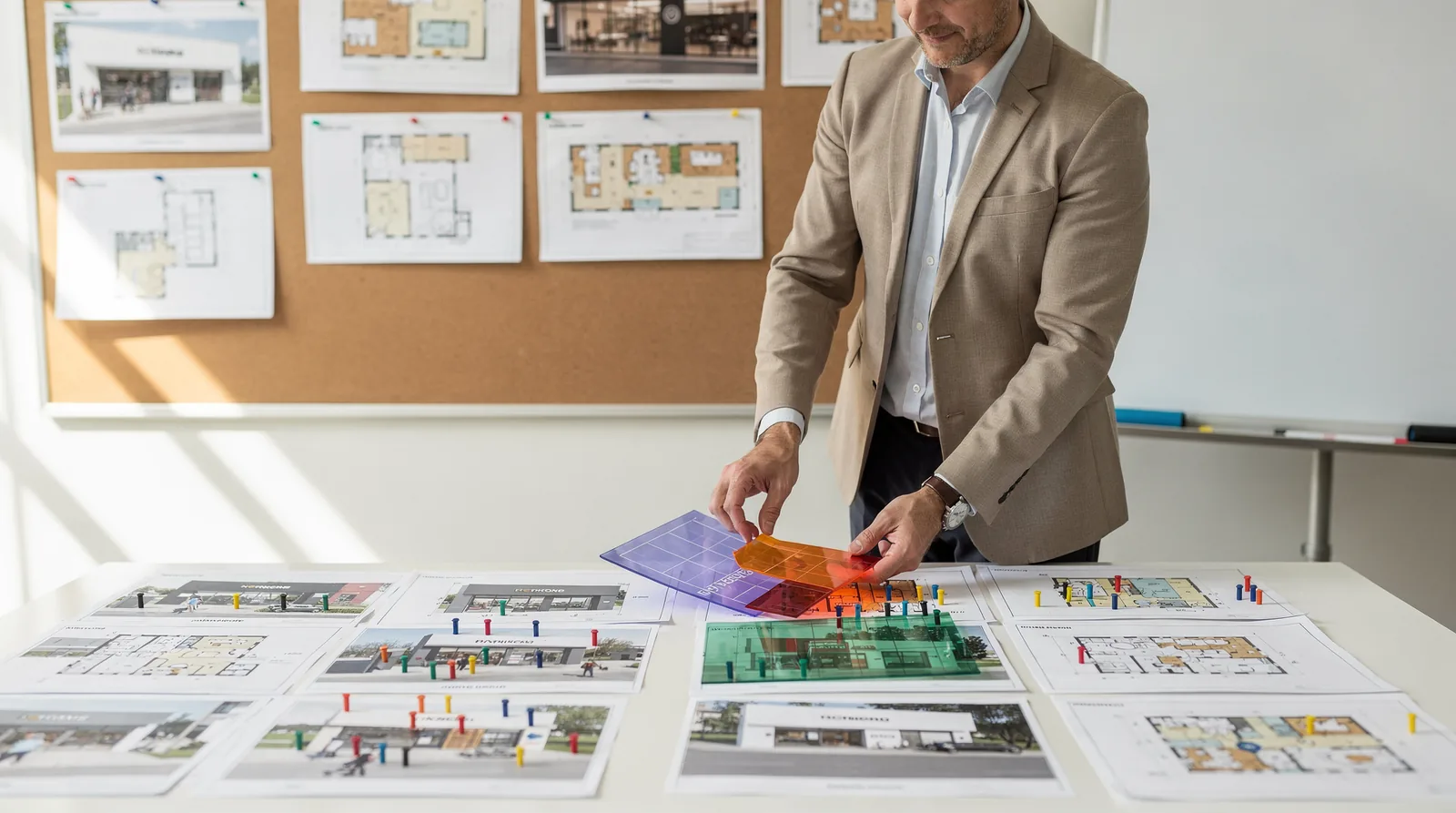
Planning a multi-unit retail buildout starts with a structured development roadmap and clear accountability frameworks. Without these, rollout timelines fracture and budgets spiral. A detailed roadmap sequences every location, trade, and inspection milestone into a single, trackable plan. Accountability frameworks assign ownership for each phase, from site surveys to final punch lists. Franchise Rollouts | Multi-Unit Restaurant & Retail Builds confirms that development checklists and accountability frameworks form the operational backbone for scaling brands. These tools prevent the drift that costs teams hours of every sprint.
What prerequisites must be in place before sequencing a rollout?
Three prerequisites anchor a successful rollout. First, secure a commercial tenant improvements contractor licensed in every target state. Second, complete prototype drawings and specifications for the franchise prototype rollout. Third, establish a master budget with line-item transparency. MHL Solutions, Inc. tailors construction solutions to client timelines and budgets with no hidden costs. This transparency lets franchise owners allocate capital across multiple sites without unpleasant surprises.
How does permitting affect the rollout schedule?
Permitting dictates the critical path. A Georgia-licensed builder manages permit and health department review paths, ensuring compliance before construction begins. Delayed permits idle crews and push opening dates past revenue targets. The contractor submits applications in parallel across jurisdictions, tracks review cycles, and resolves plan corrections immediately. This proactive approach keeps the turnkey franchise construction schedule intact.
- Finalize prototype drawings and secure landlord approvals for each site.
- Submit permit applications simultaneously across all jurisdictions.
- Order long-lead materials and equipment before breaking ground.
- Sequence construction starts so crews move efficiently from one location to the next.
- Conduct staggered final inspections and health department sign-offs.
- Execute punch lists and hand over keys for coordinated grand openings.
A turnkey franchise construction partner handles these steps under a single contract. The company coordinates subcontractors, manages inspections, and delivers each site ready for operation. Franchise owners avoid the chaos of juggling multiple vendors across state lines. The result is a predictable pipeline where every location opens on time and on budget.
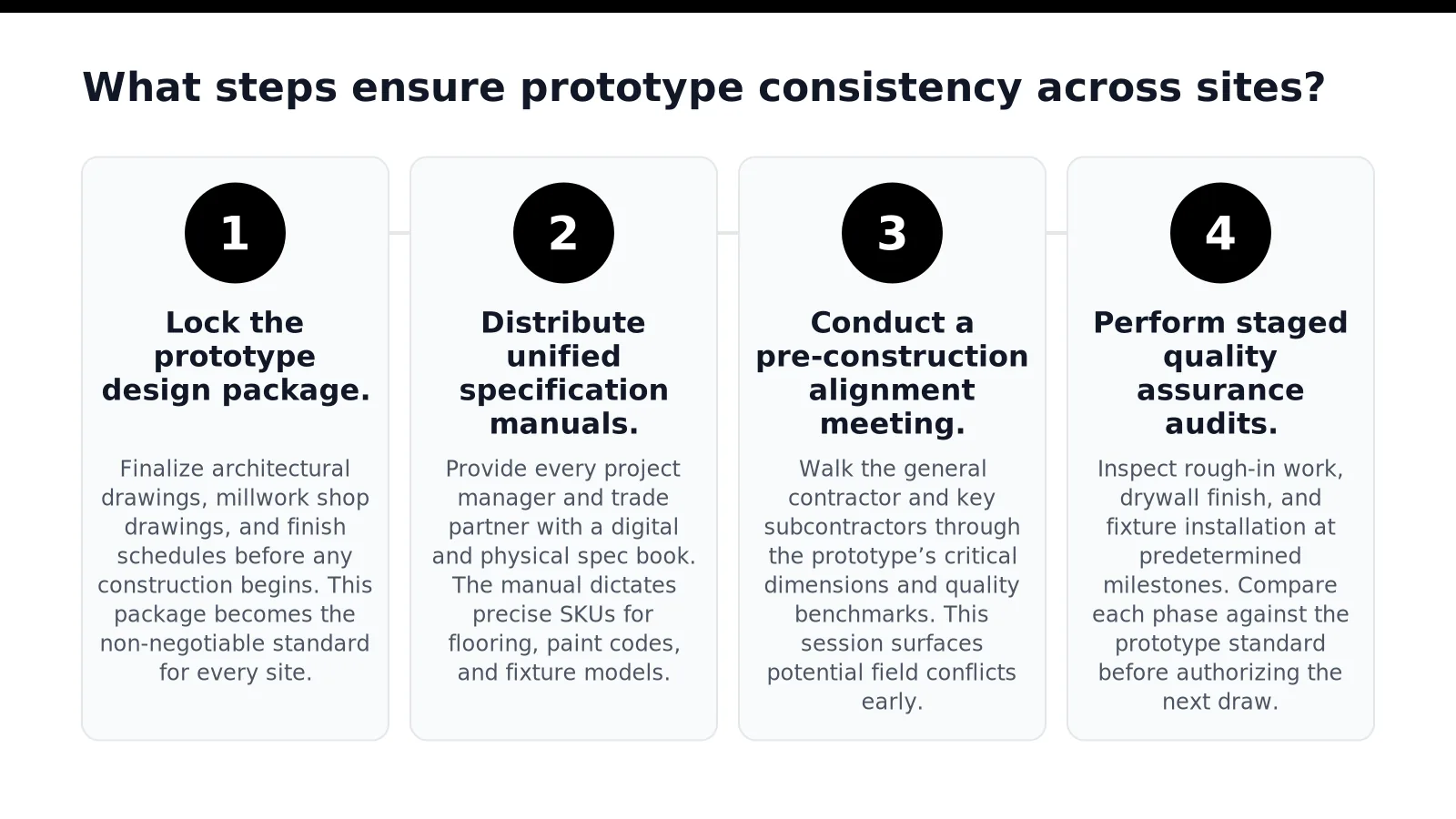
What steps ensure prototype consistency across sites?
Prototype consistency across multiple franchise locations requires a structured, repeatable process anchored in detailed documentation and vetted partnerships. Without rigorous controls, brand integrity erodes and customers encounter inconsistent experiences that damage loyalty. MHL Solutions, Inc. implements a disciplined sequence of steps to safeguard uniformity across every franchise prototype rollout.
How do specification guides prevent brand drift?
Specification guides serve as the single source of truth for every build. These documents codify exact materials, finishes, lighting packages, and spatial layouts. A multi-unit retail buildout program uses these guides to eliminate subjective interpretation by local subcontractors. The result is a portfolio of locations that look and function identically, reinforcing brand recognition.
- Lock the prototype design package. Finalize architectural drawings, millwork shop drawings, and finish schedules before any construction begins. This package becomes the non-negotiable standard for every site.
- Distribute unified specification manuals. Provide every project manager and trade partner with a digital and physical spec book. The manual dictates precise SKUs for flooring, paint codes, and fixture models.
- Conduct a pre-construction alignment meeting. Walk the general contractor and key subcontractors through the prototype’s critical dimensions and quality benchmarks. This session surfaces potential field conflicts early.
- Perform staged quality assurance audits. Inspect rough-in work, drywall finish, and fixture installation at predetermined milestones. Compare each phase against the prototype standard before authorizing the next draw.
What role does a preferred vendor network play in consistency?
A turnkey franchise construction strategy depends on a curated ecosystem of suppliers and trades. Preferred vendor ecosystems streamline procurement and enforce quality control. MHL Solutions, Inc. leverages long-term relationships with millworkers, flooring installers, and equipment suppliers who understand the prototype’s tolerances. These partners replicate the same execution across Georgia, North Carolina, South Carolina, and Tennessee without a learning curve.
How does a commercial tenant improvements contractor maintain quality?
A commercial tenant improvements contractor protects the brand by managing every detail from demolition to final clean. Full attention to detail from project start builds trust and ensures quality. The contractor verifies that storefront systems, interior partitions, and MEP rough-ins match the prototype exactly. This oversight prevents costly rework and delivers a space ready for immediate occupancy.
How do you minimize time-to-market for each site?
Minimizing time-to-market for each site demands a sequenced rollout strategy and integrated project delivery. Opening multiple locations simultaneously introduces unnecessary risk and stretches resources thin. A phased approach protects revenue and keeps schedules predictable.
Why is sequencing a franchise rollout so important?
Launching three franchise locations at once is almost always the wrong call, even when a development agreement applies pressure. Horizon Construction Team LLC notes that a staggered opening reduces risk and improves efficiency across the entire program. Each completed site generates cash flow that funds the next location. The lessons learned from one build transfer directly to subsequent projects, eliminating repeated mistakes.
What construction model accelerates multi-site delivery?
A turnkey franchise construction approach compresses timelines by consolidating pre-construction, permitting, and build-out under a single accountable entity. MHL Solutions, Inc. manages projects from initial planning through grand opening across Georgia, North Carolina, South Carolina, and Tennessee. This eliminates the gaps between design handoffs and construction starts. The design-build construction model further shortens schedules by integrating architects and builders into one team, removing the delays that fragment traditional project delivery.
How do you prevent downtime from eroding launch dates?
Every day a site sits incomplete represents lost revenue. A reliable contractor minimizes downtime and handles complex equipment installation efficiently. For multi-unit retail buildout programs, this means pre-ordering long-lead items before demolition begins. It also requires coordinating health department reviews and local inspections in parallel with finish work. MHL Solutions applies this discipline to commercial tenant improvements contractor scopes, ensuring that store-in-store kiosks and restaurant build-outs inside major retail spaces meet opening deadlines without disrupting the host location.
What makes a franchise prototype rollout repeatable?
Standardization drives speed. A documented prototype captures every specification, from millwork details to equipment rough-ins, so each new site replicates the approved model without redesign. The contractor maintains a dedicated team familiar with the brand’s standards. This consistency allows permit packages to be reused with minor site-specific adjustments. Material procurement becomes predictable, and subcontractor crews move from one location to the next with zero learning curve.
What common mistakes derail franchise rollouts?
Franchise rollouts fail when operators underestimate local code complexity and skip structured development planning. A franchise prototype rollout demands precision across every site, yet three recurring mistakes consistently delay openings and inflate budgets.
Why do local code variations cause rollout delays?
General builders often lack the specialized knowledge required for high-demand commercial zones. Atlanta’s corridors from Midtown to Buckhead and the Eastside present distinct code requirements that a commercial tenant improvements contractor must navigate precisely. Every day past the target opening date represents lost revenue that no operator recovers. MHL Solutions, Inc. manages these jurisdiction-specific hurdles through pre-construction audits, preventing the permit rejections that stall a multi-unit retail buildout.
How does missing infrastructure undermine scaling?
Operators who delay building a shared services function hit a painful ceiling. Yale School of Management research on scaling multi-unit franchise operations identifies this gap as a primary growth barrier. Without centralized procurement, design standards, and project management, consistency fractures across locations. A turnkey franchise construction approach embeds this infrastructure from the first site, giving franchisees the operational backbone they need before problems compound.
The third critical mistake involves launching without a documented franchise development roadmap. This oversight produces inconsistent execution across markets. MHL Solutions, Inc. establishes clear accountability frameworks and sequenced milestones for every project. The company’s process eliminates the guesswork that causes brand drift and costly rework during multi-site deployments.
Conclusion
A documented prototype, a sequenced rollout, and a contractor who manages every detail from pre-construction to grand opening eliminate the guesswork that derails multi-site deployments. This roadmap delivers consistent execution across every market, protecting the brand and the investment. The next step is to apply this structure to the first site, building a repeatable model for every location that follows.
Frequently Asked Questions
What is a franchise prototype rollout?
A franchise prototype rollout is the process of constructing multiple locations of a brand’s standard design across different sites, replicating a proven store model with exacting precision so every new unit matches the original specifications in layout, materials, and finishes.
How long does a typical multi-unit retail buildout take?
Timelines vary by site and jurisdiction, but a sequenced rollout with parallel permitting, pre-ordered long-lead materials, and staggered inspections compresses schedules significantly compared to launching multiple locations at once. A turnkey contractor manages these steps under a single contract to keep each site on track for its target opening date.
Why hire a turnkey general contractor instead of separate vendors for each phase?
A turnkey franchise construction approach consolidates pre-construction, permitting, and build-out under one accountable entity, eliminating the gaps and miscommunication that occur when franchise owners juggle separate vendors for design, permitting, and construction across state lines.
What states does MHL Solutions, Inc. serve for franchise rollouts?
MHL Solutions, Inc. delivers turnkey project management for multi-unit franchise, QSR, and retail buildouts across Georgia, North Carolina, South Carolina, and Tennessee.
How does a commercial tenant improvements contractor keep a rollout on-brand?
A commercial tenant improvements contractor works from locked specification manuals covering exact materials, finishes, and fixture models, then verifies storefront systems, partitions, and MEP rough-ins against the prototype at staged quality assurance audits before authorizing the next phase of work.