
Store-in-store rollouts demand a single general contractor managing every phase, from site readiness to final finishes. MHL Solutions, Inc, licensed across GA, NC, SC, and TN, coordinates multi-unit retail construction as one repeatable program. Store-in-store rollouts deliver consistency and predictability, ensuring site 40 opens as cleanly as site 1.
What defines a store-in-store rollout?
A store-in-store rollout places a branded retail concept or service kiosk inside a larger host retail environment, such as a Walmart. The model pairs a host retailer’s existing foot traffic with a brand operator’s products and identity, and it succeeds only when construction execution matches that partnership.
These projects demand specialized coordination between the host retailer and the brand operator. Both parties must align on space allocation, utility connections, and branding standards before construction begins. MHL Solutions, Inc., a licensed general contractor operating across Georgia, North Carolina, South Carolina, and Tennessee, manages that coordination as part of its store-in-store rollouts work.
How does a rollout differ from a single buildout?
A rollout is not twelve separate construction projects. It is one program executed across multiple addresses. Treating each site as an independent negotiation produces separate budgets, schedules, and store appearances at every location, according to Cook Builders. A single program system instead carries one prototype through every location, which protects brand consistency and cost control. This distinction separates multi-unit retail construction from one-off commercial tenant improvements.
What separates a rollout program from repeat buildouts?
Consistency is the dividing line. A franchise buildout contractor running a true program applies the same prototype, specifications, and schedule logic at every address. Site conditions still vary, and each host location brings its own constraints. The program absorbs those differences without renegotiating the brand standard. MHL Solutions delivers turnkey project management from pre-construction to grand opening.
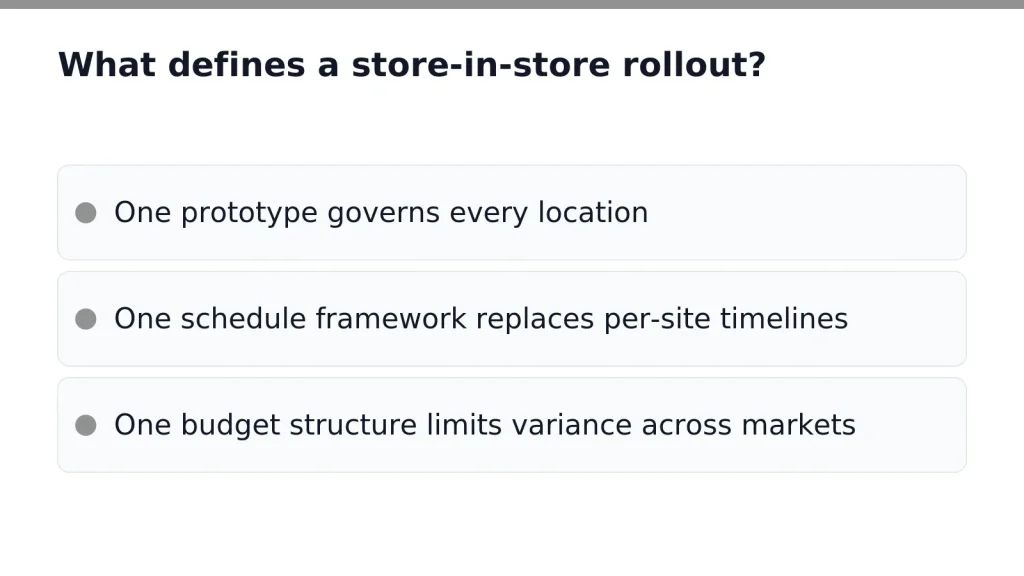
- One prototype governs every location
- One schedule framework replaces per-site timelines
- One budget structure limits variance across markets
The result is a repeatable store appearance and a predictable opening sequence, market after market.

How does multi-unit retail construction differ?
Multi-unit retail construction treats multiple locations as one coordinated program, not a series of isolated projects. A licensed general contractor operating across Georgia, North Carolina, South Carolina, and Tennessee delivers consistent execution for every site under a single brand prototype.
The difference starts with scale. Single-site construction involves one budget, one schedule, and one set of local conditions. Multi-unit retail construction replicates a proven design across many addresses while managing regional variations in permitting, labor, and site readiness. MHL Solutions, Inc. specializes in this model, applying the same standards from site 1 to site 40.
What causes multi-store rollouts to fail?
Most rollout failures stem from delayed design freezes, poor logistics planning, and excessive handoffs between vendors and installers. Each handoff creates a point where schedules slip and costs rise. Without a single accountable party, brands end up with inconsistent store conditions across markets.
What makes a multi-store rollout succeed?
Successful multi-store fixture rollouts depend on early manufacturer involvement, scalable design planning, and coordinated logistics. End-to-end project accountability ties these elements together. When one contractor manages the full sequence, from pre-construction through grand opening, the program stays predictable.
Store-in-store rollouts add another layer of complexity. These projects place restaurant concepts or service kiosks inside active big-box retail environments, requiring phased work that respects store operating hours. Commercial tenant improvements and franchise buildout contractor services follow the same programmatic logic: repeatable processes, consistent quality, and disciplined scheduling across every location.
Why choose a franchise buildout contractor?
A franchise buildout contractor specializes in replicating a brand prototype across multiple sites while holding consistency from one location to the next. That discipline separates a coordinated program from a stack of unrelated construction jobs. Brands that treat each opening as a fresh negotiation absorb the cost in mismatched budgets, drifting schedules, and storefronts that look different market to market.
MHL Solutions, Inc. operates as a licensed general contractor across Georgia, North Carolina, South Carolina, and Tennessee. The company specializes in multi-unit retail construction, applying one repeatable method to every address in a rollout. Consistency comes from process, not luck.
What does a single point of contact change?
One accountable manager carries a program from pre-construction through grand opening. Franchise operators gain a clear line of responsibility instead of a chain of handoffs between separate vendors. Fewer handoffs mean fewer gaps where details disappear.
Commercial tenant improvements and store-in-store rollouts both depend on that continuity. A kiosk or restaurant concept placed inside a host retail store adds coordination layers. One manager keeps those layers aligned.
How does one system prevent budget and schedule drift?
Prototype adaptation, permitting, and reporting run through a single system. The prototype is adapted per site, permitted per jurisdiction, and reported the same way every week. Uniform reporting exposes variance early, while it is still cheap to correct.
QSR kitchens show why execution discipline matters. A reliable contractor minimizes downtime and handles complex equipment installation efficiently. Equipment delays ripple straight into opening dates.
Franchise owners evaluating a franchise buildout contractor should weigh program experience over single-site bids. The prototype is the easy part. Repeating it is the work.
What do commercial tenant improvements cover?
Commercial tenant improvements transform an empty shell into a fully operational, brand-ready interior. The work extends far beyond cosmetic finishes. Unlike remodels that adapt existing spaces, a tenant improvement starts with unfinished space and requires complete interior construction including plumbing, electrical, and mechanical systems.
What is the difference between a tenant improvement and a remodel?
A remodel modifies an already finished space. A commercial tenant improvement begins with a raw shell. Prime Retail Services notes that a retail build-out starts with a shell and transforms it into a fully operational, brand-ready environment. This distinction matters for budgeting and scheduling. Remodels preserve existing infrastructure. Tenant improvements build everything from the ground up.
For multi-unit retail construction, the stakes compound quickly. Each location must meet the same standards across every market. Prime Retail Services emphasizes that for multi-location retailers, build-outs are not isolated construction projects. They are repeatable programs that must deliver consistency, predictability, and reliable execution across every market. A single site that deviates from the prototype creates brand fragmentation and operational inefficiencies.
How do franchise operators keep tenant improvements on budget?
Transparency in pricing prevents budget overruns. MHL Solutions tailors construction and remodeling solutions to each client’s timeline and budget with no hidden costs. This clarity is essential for franchise operators managing multiple concurrent build-outs. Unanticipated change orders on one site can cascade through an entire rollout program.
The commercial renovation process incorporates early coordination of mechanical, electrical, and plumbing systems. MHL Solutions, a licensed general contractor operating across Georgia, North Carolina, South Carolina, and Tennessee, specializes in build-outs that convert raw shell spaces into environments matching each brand’s specifications. Franchise buildout contractor services extend across quick-service restaurants and retail locations. Approaching each site with standardized methods keeps timelines predictable and protects the investment.
How to keep multi-site projects on track?
Multi-site retail rollouts stay on track when execution receives the same rigor as strategy. Most rollout failures stem from execution gaps, not flawed plans. A single missed delivery or unclear handoff between trades creates chain-reaction delays that ripple across every location in the program. According to Teamwork’s January 2026 analysis, multi-store rollouts fail more often due to execution gaps than strategy flaws.
Discipline at the installation phase prevents these cascading setbacks. Planning around real store conditions and budgeting properly for installation keeps schedules intact. When installation proceeds with clear accountability, stores open on time and brand consistency holds across every market.
What structured phases do effective rollout programs require?
Effective rollout programs follow structured phases that eliminate guesswork. Agility Retail’s June 2026 findings identify prototyping, value engineering, production, quality control, warehousing, direct-to-store delivery, and installation management as essential stages. Each phase builds on the previous one. Skipping prototyping, for example, pushes unresolved design issues into production where fixes cost exponentially more.
Why do execution gaps cause more failures than poor strategy?
Execution gaps magnify small problems into program-wide failures. A delayed fixture shipment at one location forces installers to reschedule. That reschedule bumps the next site’s start date. Within weeks, the entire multi-unit retail construction timeline fractures. Strategy documents rarely cause these breakdowns. Missed deliveries, unclear handoffs, and poor site readiness do.
MHL Solutions builds trust through full attention to detail from project start. The company’s approach reflects family-owned values of quality and sustainability, applied consistently across commercial tenant improvements and store-in-store rollouts. For franchise buildout contractor engagements, this means every site receives the same documented process, the same quality benchmarks, and the same completion standards. Structured phases combined with disciplined installation management transform a multi-site program from a collection of independent projects into one predictable system.
Conclusion
A franchise operator who selects a general contractor with documented program experience, structured phases, and single-point accountability eliminates the execution gaps that fracture multi-site timelines. That decision transforms a rollout from a series of independent projects into one predictable system, protecting both brand consistency and the capital invested in every location.