
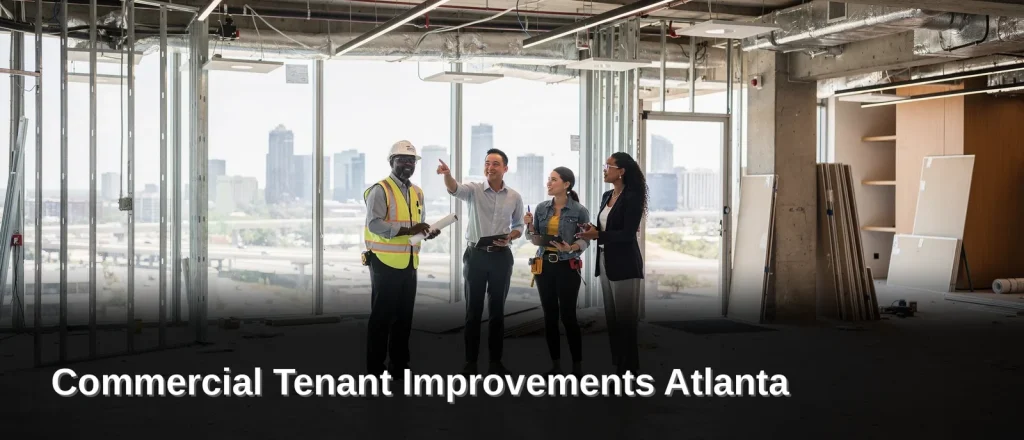
Tenant improvements in Metro Atlanta transform leased office, retail, and restaurant space into revenue-ready environments, driven by lease dates and landlord allowances. Build-out costs range from $40 to $480 per square foot depending on shell condition and scope. MHL Solutions, Inc. delivers commercial build-outs across the metro, ensuring code compliance and on-time completion.
What Are Tenant Improvements in Metro Atlanta?
Commercial tenant improvements in Atlanta transform a bare or outdated leased space into a functional business environment. These customized modifications adapt a rental property to a tenant’s specific operational requirements, aesthetic preferences, and branding goals. Without them, a business occupies a shell that works against productivity from day one.
The scope of tenant improvements varies dramatically by industry. An office build out contractor in Gwinnett County might reconfigure interior walls, install data cabling, and build out conference rooms for a professional services firm. A restaurant tenant needs commercial-grade plumbing, ventilation hoods, and fire suppression systems. Medical practices require specialized electrical loads and plumbing for exam rooms. Each build-out is unique.
What types of spaces get tenant improvements in Atlanta?
Metro Atlanta’s commercial landscape spans office towers in Buckhead, medical plazas in Sandy Springs, and retail storefronts along the Eastside corridors. Tenant improvements serve all of them. A commercial interior build out contractor handles three primary categories:
- Office spaces: Private offices, open-plan workstations, break rooms, and reception areas configured to a company’s workflow
- Medical and professional suites: Exam rooms, procedure areas, and specialized equipment zones with code-compliant utilities
- Restaurant and retail: Dining rooms, bar areas, display floors, and back-of-house operations built to health department standards
Each category carries distinct code requirements, material specifications, and equipment coordination demands that a generalist contractor often misses.
How does a tenant improvement allowance work in Georgia?
A tenant improvement allowance in GA is a negotiated sum the landlord contributes toward the build-out cost. The allowance appears in the lease as a dollar amount per square foot or a total lump sum. The tenant’s actual scope of work determines whether that allowance covers the full project or leaves a gap. A commercial general contractor in Atlanta prices the real scope against the allowance early, before lease execution. The tenant knows exactly what the landlord’s contribution buys and what additional capital the project requires.
MHL Solutions, Inc. specializes in commercial build-outs across Georgia, including restaurant, salon, and office projects. The company’s approach ties every phase to the lease commencement date, ensuring the space is ready when the tenant’s rent obligation begins. For a deeper look at how build-out agreements are structured, the company’s commercial renovations resource covers turnkey versus tenant-allowance lease models and the planning steps that keep budgets intact.

How Much Do Tenant Improvements Cost Per Square Foot?
Tenant improvement costs in Metro Atlanta span a wide range. Hard costs run from $40 to $480 per square foot, according to industry benchmarks. The final figure depends on three variables: the space type, the shell condition the landlord delivers, and the specific metro area. A vanilla-box office suite lands at the low end. A full restaurant build-out with commercial kitchen infrastructure pushes toward the top.
What Drives the Cost Range for Atlanta Build-Outs?
Space type creates the largest swing. Office interiors with standard finishes and open-plan layouts cost less than specialized environments. Medical spaces, retail storefronts, and food-service operations require mechanical, electrical, and plumbing systems that escalate the per-square-foot investment quickly.
Shell condition matters just as much. A warm shell with finished walls, ceilings, and restrooms reduces the tenant’s scope. A cold shell with exposed concrete and capped utilities shifts nearly all finish work onto the tenant’s budget. Metro Atlanta landlords deliver varying shell conditions. The same 3,000-square-foot space in Buckhead and in Gwinnett County can carry different improvement costs even before design choices enter the equation.
What Do Restaurants Cost to Build Out?
Restaurant figures reconcile to a single range in the 2026 benchmarks. Commercial kitchen infrastructure, grease interceptors, fire suppression, and health-department compliance drive costs higher than any other space type. A commercial general contractor Atlanta business owners hire must coordinate these specialized trades against a fixed opening date. Delays in equipment delivery or permit approvals compound quickly, turning a tight budget into a liquidity problem before the first customer walks in.
How Does the Tenant Improvement Allowance Work in Georgia?
A tenant improvement allowance GA landlords offer is a contribution toward construction costs, not a blank check. The allowance covers a portion of the hard costs. The tenant funds any gap between the allowance and the actual build-out price. Savvy tenants negotiate the allowance based on a real scope of work, not a square-footage guess. MHL Solutions, Inc. builds what clients envision, tailoring construction and remodeling solutions to the timeline and budget with no hidden costs. The company’s approach helps commercial tenants and property owners reconcile the allowance against the true scope before signing the lease.
What Should an Office Build-Out Cost in Gwinnett County?
MHL Solutions, Inc. prices commercial build-outs to align with the specific shell condition and intended use. A professional services office with private offices. A conference room costs more per square foot than an open-plan call center. Commercial interior build out contractor teams factor in HVAC distribution, data cabling, ceiling grid modifications, and door hardware. These line items add up differently across the $40-to-$480 range. Getting a detailed line-item estimate before lease execution prevents the allowance from falling short of the real cost.
What Is a Tenant Improvement Allowance in Georgia?
A tenant improvement allowance ga is the budget a landlord provides to customize a leased commercial space. This allowance funds the modifications that transform a generic shell into a functional office, medical suite, or retail environment tailored to the tenant’s operations.
The allowance amount varies by lease type, market conditions, and the condition of the delivered space. Landlords typically structure the allowance as a per-square-foot contribution, with benchmarks shifting across Metro Atlanta submarkets. Industry cost analysis emphasizes that understanding allowance benchmarks and the lease-economics test is critical for accurate budgeting. Without this analysis, tenants risk absorbing costs that exceed the landlord’s contribution by thousands of dollars.
How Does Allowance-Aware Pricing Work?
Allowance-aware pricing means the contractor prices the real scope against the allowance from day one. This approach prevents the common scenario where design outpaces budget, leaving the tenant to cover the gap. A contractor who builds to the allowance rather than designing first and pricing later keeps the project grounded in financial reality.
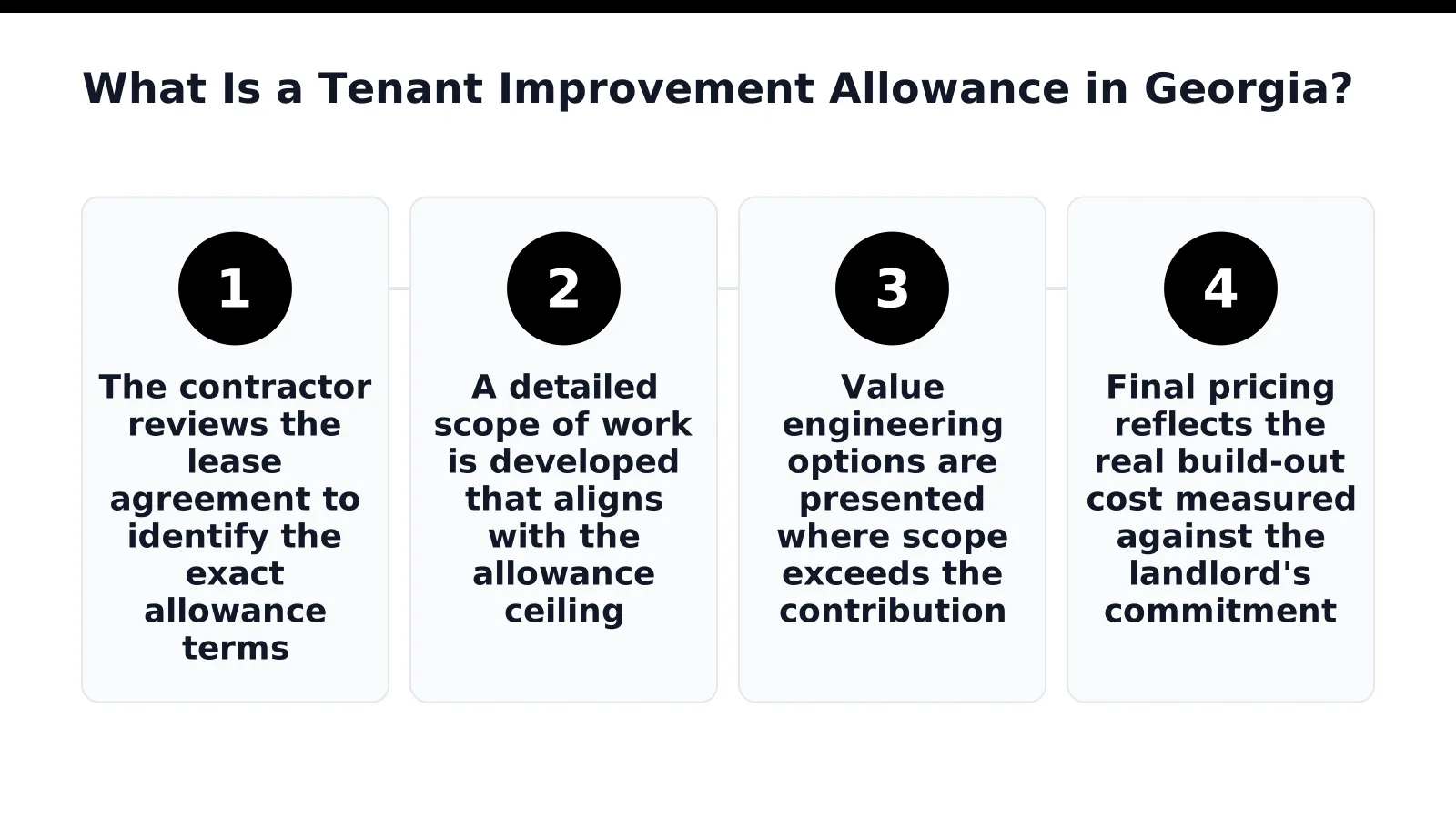
The process follows a clear sequence:
- The contractor reviews the lease agreement to identify the exact allowance terms
- A detailed scope of work is developed that aligns with the allowance ceiling
- Value engineering options are presented where scope exceeds the contribution
- Final pricing reflects the real build-out cost measured against the landlord’s commitment
What Happens When Build-Out Costs Exceed the Allowance?
Cost overruns occur when the desired scope surpasses the landlord’s contribution. The tenant covers the difference, making early allowance analysis essential. A commercial general contractor atlanta with allowance-aware practices identifies these gaps before construction begins, giving the tenant time to adjust scope or negotiate lease terms.
MHL Solutions, Inc. operates as a licensed General Contractor across Georgia, ensuring compliance with local TI allowance structures. The company’s familiarity with Metro Atlanta lease conventions helps commercial property owners and corporate tenants navigate allowance negotiations with clear, scope-driven pricing.
How to Choose an Office Build-Out Contractor in Gwinnett County?
Selecting an office build out contractor Gwinnett County demands rigorous vetting of local expertise and project management capability. The right partner prevents costly delays and ensures the finished space meets operational requirements from day one. A poor choice, by contrast, turns a scheduled build-out into a protracted, budget-draining ordeal.
What credentials should a Gwinnett County contractor hold?
A qualified contractor holds a Georgia commercial license and carries comprehensive liability and workers’ compensation insurance. The company’s track record across Metro Atlanta’s diverse commercial zones, from Midtown and Buckhead to the Eastside corridors, signals deep familiarity with local building departments. Gwinnett County’s specific permitting and inspection processes require a contractor who navigates them without missteps.
How does project management affect the build-out outcome?
The difference between a successful tenant improvement and a costly headache often comes down to experienced project management from day one. A dedicated project manager coordinates subcontractors, material deliveries, and inspections on a single, transparent schedule. Without that coordination, even well-funded projects drift past deadlines and accumulate change orders that erode the budget.
MHL Solutions, Inc. builds trust through full attention to detail in every project from the start, reflecting family-owned values. The company’s approach to commercial interior build out contractor work emphasizes clear communication and schedule adherence. Clients receive regular updates that eliminate surprises during construction.
Key evaluation criteria for a Gwinnett County contractor:
- Local regulatory knowledge: The contractor handles complex equipment installation efficiently and navigates the specific regulatory environment across Gwinnett County jurisdictions.
- Permit support capability: A contractor who manages the full permit support process, from plan review through final approval, prevents administrative bottlenecks that stall construction.
- Downtime minimization strategy: A reliable contractor sequences work to minimize disruption, keeping adjacent tenants operational during occupied-building renovations.
- Allowance-aware pricing: The contractor prices the real scope against the tenant improvement allowance ga landlords provide, identifying gaps before contracts are signed.
A commercial general contractor atlanta with deep Gwinnett County experience brings value beyond construction labor. The contractor interprets lease commencement dates against realistic build schedules and flags scope items the allowance does not cover. Business owners who skip this vetting step inherit a space that opens late and costs more than projected.
What Does a Commercial Interior Build-Out Contractor Handle?
A commercial interior build out contractor transforms a raw or outdated leased space into a functional, code-compliant workplace. The scope spans cosmetic refreshes and full-scale reconfigurations, all managed to a lease commencement date.
The work ranges from simple cosmetic updates like fresh paint and new flooring to comprehensive renovations. Comprehensive projects involve space reconfiguration, mechanical system upgrades, and specialized infrastructure installation. Without this expertise, a business risks opening delays that stall revenue generation from day one.
What types of projects fall under interior build-outs?
The project spectrum is broad. A contractor handles three primary tiers of work:
- Cosmetic updates: Fresh paint, new flooring, ceiling tile replacement, and updated lighting fixtures
- Space reconfiguration: Moving or removing walls, building new offices, and redesigning open floor plans
- Infrastructure upgrades: Electrical system modifications, HVAC adjustments, plumbing for new breakrooms or restrooms, and data cabling
Each tier demands different technical skills and permitting requirements. A licensed commercial general contractor Atlanta firms employ navigates these layers without forcing the property owner to coordinate multiple subcontractors.
How do contractors manage work in occupied buildings?
Construction inside an active office or retail center requires careful phasing. The contractor schedules noisy demolition and dust-producing tasks for after-hours windows. This approach keeps neighboring tenants operational throughout the project. Daytime work focuses on quieter activities like painting or trim installation. The sequencing protects the property owner from lease violations and tenant complaints that arise when adjacent businesses lose foot traffic.
MHL Solutions, Inc. specializes in commercial restaurant, hair and nail salon, and office build-outs across Metro Atlanta. The company’s project management approach prioritizes efficient completion. Faster project delivery enables quicker business growth and reduces the costly delays that erode a tenant improvement allowance GA landlords provide. Every week a space sits unfinished represents unrecovered rent and lost revenue, a burden no commercial tenant should carry.
How to Navigate Permitting and Code Compliance in Atlanta?
Navigating Atlanta’s permitting process demands a contractor with deep local regulatory knowledge. The city’s zoning ordinances, health codes, and building standards vary by jurisdiction, and missteps cause costly opening delays. Commercial tenant improvements Atlanta projects face particular scrutiny in high-demand corridors from Midtown to Buckhead. Code officials enforce strict compliance timelines.
What local codes affect commercial build-outs in Atlanta?
Atlanta’s regulatory landscape spans multiple authorities. Fulton County, DeKalb County, and the City of Atlanta each maintain distinct permitting requirements. Health department approvals govern restaurant and food-service spaces. Fire marshal inspections address occupancy loads and egress paths. A contractor unfamiliar with these layers risks permit rejections that push commencement dates back by weeks.
How does a contractor ensure code-compliant work?
A licensed commercial general contractor Atlanta firm manages the entire compliance chain. The contractor submits permit applications with complete architectural and MEP drawings. Inspections get scheduled at rough-in, final, and health-review stages. MHL Solutions, Inc. holds a Georgia general contractor license and operates across the state, ensuring full compliance with state and local building codes. The company’s project managers coordinate directly with plan reviewers and field inspectors.
The right contractor also anticipates site-specific challenges. Atlanta’s older building stock often triggers unexpected structural or accessibility upgrades during renovation. An experienced commercial interior build out contractor identifies these risks during pre-construction walks and builds remediation into the schedule. This proactive approach keeps the certificate of occupancy aligned with the lease commencement date.
For restaurant and food-service tenants, specialized expertise proves essential. Atlanta’s competitive foodservice market requires contractors who understand health regulations, grease interceptor sizing, and hood suppression system codes. A reliable contractor ensures the commercial kitchen is ready when the business opens and compliant with every local code. MHL Solutions, Inc. brings this specialized knowledge to office build out contractor Gwinnett County projects and restaurant build-outs alike, minimizing downtime through efficient project completion.
Why Choose MHL Solutions for Metro Atlanta Build-Outs?
MHL Solutions, Inc. delivers commercial build-outs across Metro Atlanta on time and within budget. The company’s licensed general contractor status across Georgia, North Carolina, South Carolina, and Tennessee backs every project with regulatory compliance and multi-state accountability. Commercial property owners and facility managers lose both revenue and tenant goodwill when a build-out misses its commencement date. MHL Solutions prevents that loss through disciplined project management and transparent scheduling from day one.
The company specializes in three high-demand build-out categories that dominate Metro Atlanta’s commercial leasing market:
- Commercial restaurant build-outs requiring health-code compliance and equipment coordination
- Hair and nail salon build-outs with specialized plumbing and ventilation demands
- Office build-outs that balance open-plan functionality with private workspace needs
This focused specialization means the team understands the specific code requirements, material lead times, and subcontractor sequencing each category demands. A generalist contractor learning these nuances on the job introduces delay risk that a specialized commercial general contractor Atlanta property owners hire avoids entirely.
How does MHL Solutions handle the tenant improvement allowance process in Georgia?
A tenant improvement allowance GA lease provision creates a fixed budget the landlord contributes toward the build-out. MHL Solutions prices the real scope against that allowance before construction starts. The company’s approach prevents the common scenario where a tenant discovers mid-project that the allowance falls short of the actual cost. Early cost transparency lets commercial tenants negotiate lease terms or adjust scope while options still exist.
What makes MHL Solutions different from other office build-out contractors in Gwinnett County?
An office build out contractor Gwinnett County tenants select must coordinate with occupied building protocols and suburban permitting timelines. MHL Solutions builds trust through full attention to detail in every project from the start. The company’s design-build approach integrates design and construction under one entity, which minimizes project timelines and ensures budget certainty. For commercial tenant improvements Atlanta stakeholders managing multiple properties, this single-point accountability simplifies oversight. A commercial interior build out contractor operating without integrated design risks the finger-pointing between architect and builder that stretches schedules and inflates change orders. MHL Solutions eliminates that gap.
Atlanta Tenant Improvements: Key Takeaways for Business Owners
For Metro Atlanta business owners planning a commercial build-out, selecting a contractor with specialized expertise in restaurant, salon, and office spaces eliminates the costly delays that erode tenant improvement allowances. MHL Solutions, Inc. delivers code-compliant projects on schedule through disciplined project management and transparent budgeting. The next step involves scheduling a pre-construction walk to align the build-out scope with the lease commencement date.
Frequently Asked Questions
What is included in a commercial tenant improvement build-out in Atlanta?
A commercial tenant improvement build-out typically covers interior walls, flooring, ceilings, lighting, HVAC, plumbing, and electrical work needed to adapt a leased space to a tenant’s operations. The exact scope depends on the business type: an office needs workstations and conference rooms, while a restaurant requires commercial kitchen infrastructure, grease interceptors, and fire suppression systems.
How much does a tenant improvement allowance typically cover in Georgia?
A tenant improvement allowance in Georgia is a negotiated, per-square-foot or lump-sum contribution from the landlord toward construction costs. Whether it covers the full project depends on the tenant’s actual scope of work. Pricing the real scope against the allowance before signing the lease shows tenants exactly what the allowance buys and whether additional budget is needed.
How long does an office build-out take in Gwinnett County?
Timelines vary with scope, permitting, and shell condition, but build-outs are scheduled against the lease commencement date so the space is ready when rent obligations begin. Experienced project management, with coordinated subcontractors, deliveries, and inspections, keeps the schedule on track and avoids the delays that push back opening day.
What permits are required for a commercial build-out in Metro Atlanta?
Permit requirements depend on jurisdiction (Fulton County, DeKalb County, or the City of Atlanta) and space type. Restaurant and food-service spaces need health department approval, while all projects require building permits and fire marshal inspections covering occupancy loads and egress. A licensed general contractor manages the full permit application and inspection process.
Does MHL Solutions handle restaurant, salon, and office build-outs in the same project?
MHL Solutions specializes in commercial restaurant, hair and nail salon, and office build-outs across Metro Atlanta, and the company holds a General Contractor license across Georgia, North Carolina, South Carolina, and Tennessee. This focused specialization means the team manages the distinct code requirements and trade coordination each space type demands, whether a project involves one category or several.